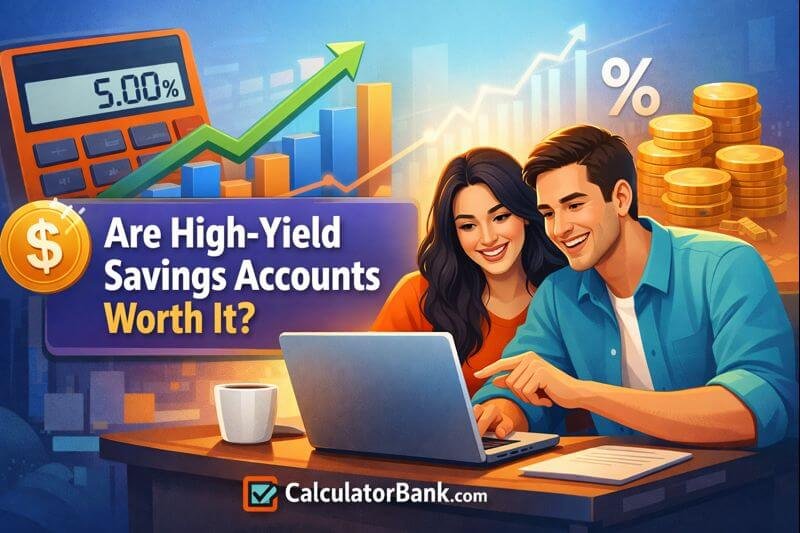
Are High-Yield Savings Accounts Worth It? High-yield savings accounts gained massive attention over the past few years as interest rates climbed.
But as we are already in 2026, many savers are asking whether these accounts still make sense.
Rates may shift, inflation may cool or rise again, and alternatives continue to compete. Deciding if a high-yield savings account is worth it in 2026 depends on how rates move, how you use your cash, and what trade-offs you’re willing to accept.
How High-Yield Savings Accounts Look In 2026
In 2026, high-yield savings accounts are expected to remain widely available, especially from online banks. These accounts still offer rates well above traditional savings accounts, though yields may fluctuate more than they did during peak rate periods. Banks adjust rates based on Federal Reserve policy, competition, and funding needs.
Even if rates decline, many high-yield savings accounts should continue to pay meaningfully more than brick-and-mortar savings accounts. For savers who want a simple place to park cash without market risk, this keeps them relevant into 2026.
Interest Rates Matter, But They Aren’t Everything
The main draw of a high-yield savings account is the interest rate, but focusing only on APY can be misleading.
Rates are variable, meaning today’s return is not guaranteed next month or next year. In 2026, rate changes could be slower or more frequent depending on economic conditions.
What matters more is how the account performs over time. A slightly lower rate paired with no fees and steady adjustments may outperform a headline rate that drops quickly. Comparing long-term behavior is more useful than chasing short spikes.
You can estimate real earnings using this tool:
https://calculatorbank.com/high-yield-savings-account-calculator/
Liquidity Remains a Major Advantage in 2026
One reason high-yield savings accounts continue to stand out is access. Your money is not locked up, and transfers are usually available within a few days. This flexibility matters just as much in 2026 as it did before.
For emergency funds, job transitions, or unpredictable expenses, liquidity beats slightly higher returns elsewhere.
Unlike CDs or Treasuries, you don’t have to plan withdrawals around maturity dates. That ease of access keeps high-yield savings accounts practical even if rates soften.
Safety and FDIC Coverage Still Hold Strong
High-yield savings accounts remain among the safest places to store cash. Most are FDIC-insured up to $250,000 per depositor, per bank, including interest. That protection does not change in 2026.
For risk-averse savers, this safety is a key reason these accounts stay attractive. While market investments may offer higher potential returns, they also come with volatility. High-yield savings accounts protect principal while still paying interest, which keeps them relevant during uncertain periods.
Fees Can Decide Whether They’re Worth It
In 2026, the best high-yield savings accounts will still be the ones with few or no fees. Monthly maintenance fees, balance requirements, or transfer charges can quietly reduce returns, especially if rates are lower than before.
A good account should let interest work without forcing constant balance management. When comparing options, fee structure can matter more than a small difference in APY.
Always check:
- Monthly maintenance fees
- Minimum balance rules
- Transfer or withdrawal charges
Taxes Reduce Real Returns in 2026
Interest earned from high-yield savings accounts is taxed as ordinary income. Federal taxes apply, and state taxes usually do as well. This means the rate you see is not what you keep.
In 2026, after-tax returns may matter more as rates normalize. For higher earners or savers in high-tax states, taxes can reduce the appeal compared to options like Treasuries, which avoid state income tax.
Related reading:
- High-yield savings account vs CD account: What Is Better?
- High-Yield Savings Account vs Money Market Account
- How Interest Is Calculated on High-Yield Savings Accounts
- https://calculatorbank.com/category/personal-finance/
How High-Yield Savings Compare to Other Options in 2026
High-yield savings accounts don’t exist in isolation. Savers often compare them to money market accounts, CDs, and Treasuries.
Compared to money market accounts, savings accounts often offer simpler access. Compared to CDs, they avoid lock-ups and penalties. Compared to Treasuries, they trade tax advantages for ease and flexibility.
You can compare growth scenarios here:
https://calculatorbank.com/money-market-account-calculator/
Each option fits a different role, which is why high-yield savings accounts remain part of many strategies.
Who High-Yield Savings Accounts Are Worth It For
In 2026, these accounts still make sense for many savers.
They are a strong fit for:
- Emergency funds
- Short-term savings goals
- Cash reserves between investments
- Savers who value flexibility over fixed returns
If you expect to need the money without notice, the trade-off in yield is often worth it.
When High-Yield Savings Accounts May Fall Short
High-yield savings accounts are not ideal for every situation. If rates fall sharply in 2026, returns may lag other fixed-income options. Long-term savers who don’t need access may find better outcomes elsewhere.
They may not be the best choice if:
- You won’t need the money for years
- You want guaranteed returns
- You want better tax efficiency
In those cases, CDs or Treasuries may be more suitable.
Using High-Yield Savings Accounts Strategically in 2026
Many savers use high-yield savings accounts as part of a larger plan rather than a single solution. Keeping emergency cash liquid while placing longer-term funds in CDs or Treasuries balances access and returns.
This layered approach reduces risk while keeping money available when needed. In 2026, strategy often matters more than picking a single “best” account.
Are High-Yield Savings Accounts Still Competitive Long Term?
Even if rates decline, high-yield savings accounts are likely to remain competitive relative to traditional savings accounts. Banks continue to compete for deposits, especially online institutions with lower costs.
As long as the rate gap remains wide, these accounts will continue to offer value. The key is choosing accounts with consistent policies rather than chasing short-term promotions.
FAQs: High-Yield Savings Accounts in 2026
Will high-yield savings rates drop in 2026?
Rates could fall or level out depending on economic conditions. Since rates are variable, banks can adjust them at any time.
Are high-yield savings accounts still good for emergency funds?
Yes. Easy access and FDIC protection make them one of the most practical places for emergency savings.
Do high-yield savings accounts keep up with inflation?
They may help reduce inflation’s impact, but they do not guarantee purchasing power growth. Their role is stability, not aggressive growth.
Should I move my savings if rates fall?
Not always. If fees are low and access is good, switching accounts for small rate differences may not be worth the effort.
Can I use more than one high-yield savings account?
Yes. Some savers separate funds by goal using multiple accounts, though managing fewer accounts is often simpler.
Bottom Line
High-yield savings accounts are still worth it in 2026 for savers who value safety, access, and simplicity. While rates may not stay at recent highs, these accounts continue to outperform traditional savings options and play a key role in cash management. The right account, paired with a clear purpose, can still earn a place in your financial plan.